Why Furniture Joints Loosen in East Texas Humidity, and the Fix
A chair that wobbles every August and feels solid again in February isn't haunted. It's doing what wood does. Wood is hygroscopic, meaning it takes on and gives up moisture until it balances with the air around it. The USDA Forest Products Laboratory calls that balance point the equilibrium moisture content, and it tracks relative humidity closely. In a Kilgore house in July, with the door opening all day and the AC fighting 80-percent outdoor humidity, the wood in your furniture may sit around 10 to 12 percent moisture content. Come January, with the heat running and indoor humidity dropping into the 30s, that same wood can fall to 6 or 7 percent. Every point of change means the wood physically changes size.
It doesn't change size evenly, either. Wood moves very little along its length, a fair amount across the grain radially, and about twice that much tangentially. So a round tenon in a round mortise doesn't shrink into a smaller circle. It shrinks into an oval. Purdue Extension's bulletin on shrinking and swelling shows exactly this: dowels and mortises go elliptical, and the hole and the peg end up out of round in different directions.
What actually breaks in the joint
Three things fail, usually together. First, geometry. Once the tenon is oval and the mortise is oval the other way, they only touch in two places instead of all the way around. Second, the glue line. Glue is brittle and thin. When the parts move against each other season after season, the bond cracks loose in the joint even though nothing looks broken from outside. Old hide glue also gets crystalline and chalky with age and heat, and a hot attic or a storage building will speed that along fast. Third, compression set. Swollen wood inside a tight joint has nowhere to go, so the fibers crush a little. When it dries back down, the crushed fibers don't spring back and the joint is permanently slack.
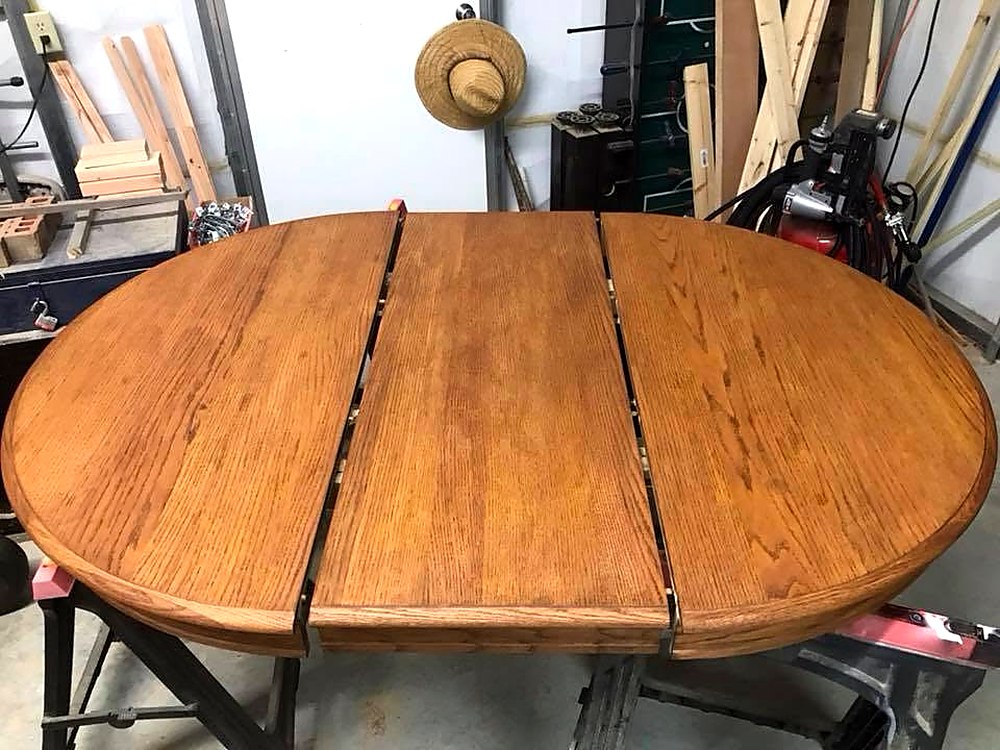
You'll see the same thing in corner blocks that pull away from the rails, in glue lines that stand up as ridges, and in screws that back out of end rails because the wood around them shrank. A tabletop that's screwed down tight through solid rails is the classic East Texas casualty. The top wants to move a quarter inch across its width between seasons, can't, and splits instead.
Things that make it worse here
Unconditioned storage is the big one. A garage, a shed, a barn, or a carport in our climate runs the moisture content up and down far harder than any room in your house. Damp storage also puts wood into the range where anobiid powderpost beetles can develop, which is why University of Kentucky entomologists point at wood moisture around 13 percent and above as the risk zone. If you see fine powder and round exit holes about 1/16 to 1/8 inch across, that's beetles, not a loose joint.
Pine is worth a word, since we're surrounded by it. Softwood furniture is more forgiving about splitting but less forgiving about fasteners. Screw holes in pine strip out and stay stripped.
How a joint gets fixed properly
A loose joint is not a glue problem, so squirting glue into the gap doesn't fix it. The glue has no clean surface to grab and the joint is still loose underneath. Neither do L-brackets, wood screws driven through the rail, or swelling compounds. They buy a few months and make the real repair harder.
The honest repair goes like this. Knock the joint apart, carefully, in the direction it went together. Clean every trace of old glue off both surfaces by scraping, not sanding, since sanding removes wood and rounds off shoulders that need to seat flat. Round mortises get cleaned out with a drill bit run backward first, then forward, so it doesn't enlarge the hole. Then re-fit. A slack tenon gets shimmed with veneer or plane shavings, or gets built back up so it fills the mortise again. Only then does glue go on, with clamps set perpendicular to the glue line and moderate pressure, and the piece checked for square and sitting flat before it cures.
Glue choice matters. Hide glue stays reversible and bonds to itself, which is why conservators favor it on older pieces that will need work again someday. PVA is fine for clean, tight modern joints. Epoxy earns its place when the wood is punky and gaps have to be filled, but it makes future disassembly hard, so it isn't a first resort.
Prevention is dull but effective: keep furniture inside conditioned space, run the AC or a dehumidifier in summer, keep pieces off exterior walls and out of direct sun, and don't park anything over a floor vent. Finish slows moisture exchange but never stops it, and the Canadian Conservation Institute makes the point that steady conditions matter more than any product you can wipe on. Finishing the underside and back of a piece helps both faces move at the same rate.
If a joint is past a reglue, or you'd rather it be done once and done right, Grace Woodwork in Kilgore handles furniture repair and refinishing along with custom furniture, cabinets, built-ins and wood signs. Send a photo through the website for a quote, or call 903-445-7477, Monday through Friday, 9 to 5.
Sources
- USDA Forest Products Laboratory, Wood Handbook Ch. 4: Moisture Relations and Physical Properties of Wood
- Purdue University Extension FNR-163, The Shrinking and Swelling of Wood and Its Effect on Furniture
- Canadian Conservation Institute Notes 7/2, Care of Furniture Finishes
- University of Kentucky Entomology ENTFACT-616, Powderpost Beetles
- Canadian Woodworking, Intermediate-level Chair Repair
- USDA Forest Products Laboratory, Wood Handbook Ch. 12: Drying and Control of Moisture Content